
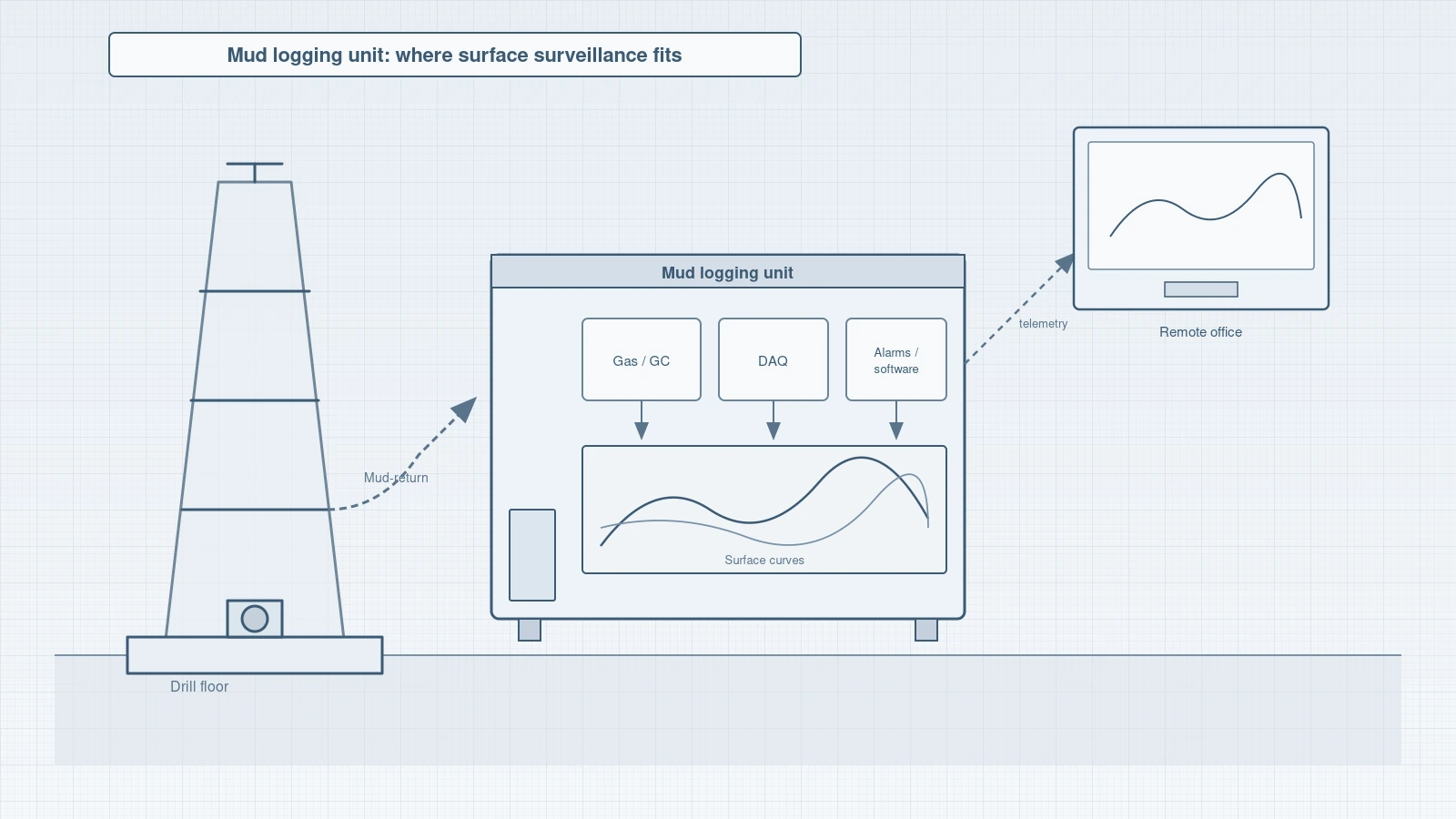
A mud logging unit is a surface package that brings formation-gas analysis, drilling-parameter acquisition, and safety alarms together at the wellsite—typically in a cabin or container with chromatograph, data acquisition, and software. It is not a cuttings-weighing module with a different label, and it is not a downhole LWD tool string. Enquiries stall when they say “send mud logging unit” before anyone writes down the surveillance object, data consumers, gas path, channel needs, cabin class, software/telemetry, and which adjacent scopes stay on separate RFQ lines.
This page is a mud logging unit selection guide: when a surface mud logging unit / SLS package fits your drilling surveillance plan, and what to put in the RFQ so offers are comparable. If you are still working out how to build the overall mud-logging system around a data objective, start with Build the mud logging system around the data objective. This article covers the narrower decision: when the unit package belongs on the shortlist.
Who this page is for
- Drilling, geology and wellsite engineers deciding whether a surface mud-logging cabin with gas analysis and integrated data acquisition belongs in the surveillance plan—or whether cuttings return, downhole LWD, or a sensor-only add-on is the real object.
- EPC and project teams keeping mud logging unit, cuttings weighing, LWD/MWD, and individual surface sensors scopes separate before the RFQ is frozen.
- Procurement engineers writing enquiries that name well program, data consumers, gas path, channel layout, cabin/cert options, software/telemetry and acceptance tests—not a bare product name and a brochure screenshot.
First principles: what a surface mud logging unit changes
Write down the surveillance job before choosing any cabin or chromatograph. Five facts drive most surface mud-logging unit decisions:
- The unit sits at surface. Gas from the mud returns, drilling parameters from sensors on pumps/pits/standpipe, and alarm logic are acquired and displayed in a cabin or container. That is a different object from downhole formation sensors on an LWD string.
- Gas + parameters + alarms are the usual bundled job. A typical surface package combines total-gas / chromatograph work, multi-channel data acquisition, and safety alarm coverage under one software surface. Splitting those into three unrelated POs without interfaces creates integration debt.
- The data consumer defines the interface. Mud-logging crew, drilling office, remote operations centre, or a third-party historian each imply different software, WITS/telemetry and acceptance tests.
- Cabin class and hazardous-area options are project fields. Explosion-proof / positive-pressure choices, fire rating and any DNV framing on the live pages are selection language to confirm against the wellsite and the offer.
- Proof is usable curves and alarm behaviour, not a label. Without a channel list, gas path, lag expectations and who owns interpretation, nobody can say the unit fitted the job.
The live CNPS product page for Mud Logging Unit frames an SLS-series surface package with chromatograph, RS-485 acquisition, CO₂ analysis and certified cabin themes as published. Whether that package fits your well depends on the fields below.
Start with the surveillance object, not the SKU

Lock these fields before freezing cabin size, channel count or chromatograph options. Blank fields force the quote to guess—often the wrong monitoring object (full unit vs cuttings weighing vs LWD vs sensor-only), not only the wrong cable type.
| Condition field | What to capture | Why it matters for a mud logging unit |
|---|---|---|
| Well program / surveillance object | Formation-gas watch, drilling-parameter surveillance, kick/loss support, geologic steering support, or combined surface logging job (state which) | Defines whether a full surface unit fits vs cuttings weighing, LWD, or sensor-only add-ons |
| Data consumers | Mud-logging cabin crew, drilling office, remote centre, historian/SCADA (who acts on curves and alarms) | Wrong consumer → wrong software/telemetry assumption |
| Gas path | Degasser / sample line ownership; total-gas vs C1–Cn needs; lag expectations; CO₂ watch yes/no | Sets chromatograph and analyzer scope; live page frames Fast GC and SL-IR-II CO₂ ranges as published—confirm on offer |
| Channel needs | Analog and pulse channel counts needed; which sensors feed the unit vs stay on separate RFQs | Live page frames RS-485 DAQ with 40 analog + 14 pulse channels as published—match to your list, do not invent extras |
| Cabin class / cert options | Hazardous-area class; positive-pressure / explosion-proof need; any DNV / fire-rating expectation | Live page frames DNV-certified positive-pressure Zone I container, DNV A0 / IEC79-13 / A-60 themes as published—confirm project requirement on datasheet |
| Software / telemetry | WITS or other protocol; on-site only vs remote (3G/GPRS/CDMA or project equivalent); who owns interpretation software | Live page frames WITS and remote options as published—verify against your network plan |
| Sensor scope boundary | Sensors included in the unit RFQ vs separate pump-stroke / pit / flow / cuttings RFQs | Avoids silent SKU explosion inside one PO line |
| Adjacent paths | Cuttings weighing still open; LWD/MWD still open; service-company crew vs equipment-only RFQ | Unit ≠ cuttings return ≠ downhole LWD ≠ full service crew |
When a mud logging unit fits

A surface mud logging unit is worth a serious look when most of the following are true:
- The monitoring job is surface gas + drilling parameters + alarms together, not only cuttings return weight and not only downhole formation questions.
- Someone owns the cabin data in real time—mud-logging or drilling personnel will act on curves and alarms, not only archive a file.
- You can state the gas path and channel list—degasser/sample ownership, chromatograph needs, and which analog/pulse inputs the unit must accept.
- Cabin class and hazardous-area expectations are discussable—container type, positive-pressure / explosion-proof needs, and any DNV or fire-rating language the project requires, confirmed against the offer.
- Software and telemetry are ownable—WITS or equivalent, local vs remote viewers, and who signs off interpretation.
- The unit RFQ stays separate from cuttings weighing, LWD/MWD, and individual sensor add-on RFQs, each with its own acceptance test.
- Equipment supply vs crewed service is explicit—package with your (or a nominated) crew, or a full mud-logging service company.
Field check: Cuttings-return weight only → cuttings weighing path. Downhole formation / LWD → LWD path. System architecture still open → pillar first, until the unit package is the written object.
When other paths usually win first
| Situation | Look at first | Why a full mud logging unit is secondary |
|---|---|---|
| Only cuttings return / hole-cleaning weight is open | Cuttings Weighing System: When Real-Time Cuttings Return Monitoring Fits Drilling Wellbore-Cleanliness Service (Selection & RFQ Fields) | Cuttings weight ≠ cabin + chromatograph + full DAQ |
| Need is downhole formation / LWD sensors | What Are LWD Products? Oilfield Logging-While-Drilling Sensors and Tools Explained | Downhole tools ≠ surface unit |
| Only one or two surface sensors (for example pump stroke or pit level) | Sensor-only RFQ lines | Individual sensors are separate RFQs—do not force a full cabin |
| System architecture / data-objective design is still open | Mud-logging pillar (linked above) | Architecture first; unit package later |
| Full crewed mud-logging service is the commercial model | Service-company scope (crew, interpretation, reporting) | Equipment RFQ ≠ service crew RFQ |
| No gas path, no channel list, no data consumer written down | Write those fields before any SKU | Label alone does not define the object |
Mud logging unit vs cuttings weighing vs LWD vs sensors (keep the scopes separate)

The labels overlap in conversation; the objects do not. A mud logging unit is the surface package decision only.
| Scope | Typical decision | Acceptance evidence you would expect |
|---|---|---|
| Mud logging unit (this page) | When a surface cabin/package with gas + DAQ + alarms fits | Channel list met; gas curves usable; alarms tested; cabin/cert as offered |
| Cuttings weighing | When cuttings-return weight monitoring fits hole cleaning | Weight curves over shakers; module layout as offered |
| LWD / MWD | When downhole formation or drilling mechanics sensors fit | Tool string, survey/log quality, BHA constraints |
| Individual surface sensors | When a single measurement (pit, stroke, flow) is the object | Sensor calibration and interface only |
| Crewed mud-logging service | When people + interpretation + reporting are in scope | Crew tickets, report format, handover—not only hardware FAT |
Writing one PO line that mixes “mud logging unit + cuttings weighing + LWD + wireless pump sensors” without separate data objectives and acceptance tests creates the wrong evidence pack for each scope. Sensors beyond the unit’s stated channel list stay on separate RFQs if needed—do not explode SKUs here.
What the live product pages already state (honesty bounds)
As published on the live CNPS product page Mud Logging Unit (post 664, checked 2026-11-01):
- Product framing: SLS-series mud logging equipment designed and manufactured with an internationally renowned mud-logging partner; large data volume, rich information, fast processing and accurate interpretation themes as published.
- Cabin / hazardous area: DNV-certified positive-pressure explosion-proof container for Zone I rig sites; cabin built to DNV A0 grade and IEC79-13 standards with A-60 fire-proof protection language as published.
- Gas analysis: Fast Gas Chromatograph with cycle time ≥30 seconds and minimum detectable concentration 10 ppm; CO₂ via SL-IR-II infrared analyzers with detection range 0.2%–100%; FID detectors with baseline noise ≤30 pA as published.
- Data acquisition: RS-485 system featuring 40 analog and 14 pulse signal channels as published; wireless DAQ with IP67 explosion-proof design and continuous operation framing for 20+ days as published.
- Integration: WITS protocol compatibility; remote transmission options via 3G, GPRS or CDMA as published.
- Sibling page (744) SLS Mud Logging Unit: SLS-3 framing, selectable DNV 2.7-1 option, GC-3K, CO₂ analyzer, SAS alarm and SLS-3 software as published—confirm on the project datasheet. Prefer primary catalogue page 664 when matching a configuration; no second money CTA.
Honesty bound: Not a certified performance sheet for your well. Cycle times, ppm floors, channel counts, IP ratings and DNV/IEC language are cited as published; confirm every figure on the offer and datasheet. No invented certificate numbers, monogram details, ROI or accuracy % appear here.
RFQ fields that keep mud logging unit quotes comparable
Copy these into the enquiry so replies stay comparable.
| RFQ field | What to write | Honesty bound |
|---|---|---|
| Surveillance-object intent | Surface mud logging unit / SLS package for gas + drilling params + alarms (state primary job) | Do not hide an open cuttings-only or LWD-only debate |
| Well / section identity | Field/well ID; hole sections; fluid system notes; hazard class | Unknown is better than invented geology |
| Data consumers | Cabin crew, drilling office, remote centre, historian—who acts | Wrong consumer → wrong interface |
| Gas path | Degasser/sample ownership; total-gas / C1–Cn; CO₂ yes/no; lag notes | Compare with published GC / CO₂ framing as published; confirm on offer |
| Channel list | Analog and pulse inputs required; sensors in vs out of unit scope | Match to published 40 analog + 14 pulse framing as published—or state extras as separate RFQs |
| Cabin / cert options | Positive-pressure / Zone need; DNV / fire-rating expectation; size limits | Confirm offered container class—no assumed cert numbers |
| Software / telemetry | WITS or other; local vs remote; interpretation ownership | Confirm offered software scope and network path |
| Wireless / DAQ notes | Wired RS-485, wireless DAQ, or both; site RF/EMI notes | Live page frames wireless DAQ themes as published—verify for site |
| Evidence / FAT-SAT | Factory and site acceptance tests; packing; destination; spares | No fake certificate numbers |
| Related scopes | Separate RFQs for cuttings weighing / LWD / sensor add-ons / crewed service, or “none” | Keep objects separate |
| Project ID + engineer | Who owns duty and acceptance; logistics | Required for comparable replies |
For live catalogue framing and the published SLS / chromatograph / DAQ / cabin notes, see Mud Logging Unit when you are ready to match an offered configuration.

When the fields above are filled in, send them through Request a quotation so the offer is priced against your surveillance object, not a generic brochure pack.
FAQ
Is a mud logging unit the same as a cuttings weighing system?
No. A mud logging unit is a surface package that typically bundles gas analysis, multi-channel data acquisition and alarms in a cabin. A cuttings weighing system monitors cuttings-return weight over the shale shakers for hole-cleaning and wellbore-cleanliness trends. Keep them on separate RFQ lines when both are in scope.
Does a mud logging unit replace LWD?
No. LWD answers downhole formation and drilling-mechanics questions on the tool string. A surface mud logging unit answers surface gas and parameter surveillance. Many wells use both; they are not substitutes.
Do I need a full unit if I only need one or two sensors?
Usually not. Individual surface sensors (pump stroke, pit level, flow-out and similar) stay on separate RFQs unless you have written down why they must live inside a cabin package. Do not force a full unit for a label alone.
Are the published GC cycle time and ppm figures guarantees for every well?
No. The live product page lists Fast GC cycle time ≥30 seconds and minimum detectable concentration 10 ppm as published. Treat them as catalogue framing to confirm on the datasheet and offer for your gas path and lag needs—not a universal project guarantee invented here.
Equipment RFQ or crewed mud-logging service?
Say which you want. An equipment RFQ prices cabin, analyzers, DAQ and software against your channel list and cert options. A crewed service RFQ adds people, interpretation and reporting. Mixing them without saying so produces offers you cannot compare.
What is the single most useful RFQ field?
A written surveillance object plus a channel list and data consumer. Without those, offers cannot be compared and FAT/SAT cannot be judged.
Talk to engineering
If surface gas and drilling-parameter surveillance is the binding job and a mud logging unit is on the shortlist, start here: Talk to an Engineer. For commercial follow-up, email sales@cnps.com once with the same surveillance-object note, well/section identity, data consumers, gas path, channel list, cabin/cert options, software/telemetry notes, related-scope list and project ID.


