
GRE Tubing — Spec the Well String Before You Quote a Flowline
Procurement teams search GRE tubing when a well program already calls for glass-reinforced epoxy in the hole — often a water-injection, sewage-reinjection, polymer-injection, or similar downhole string. The RFQ still fails when that line is copied from a flowline datasheet, or when “GRE pipe” is used for both the tubing tally and the surface line. This page is a buyer brief: how to tell tubing from line pipe, which product path to open, and which fields make a quote comparable. It is not a resin encyclopedia.
CNPS lists well-duty product pages for API 15HR GRE tubing and API 15LR GRE tubing, with the systems overview on fiberglass pipes. Send one controlled brief through request a quote. Confirm every rating, joint, and edition against the construction actually offered — not against a search phrase.
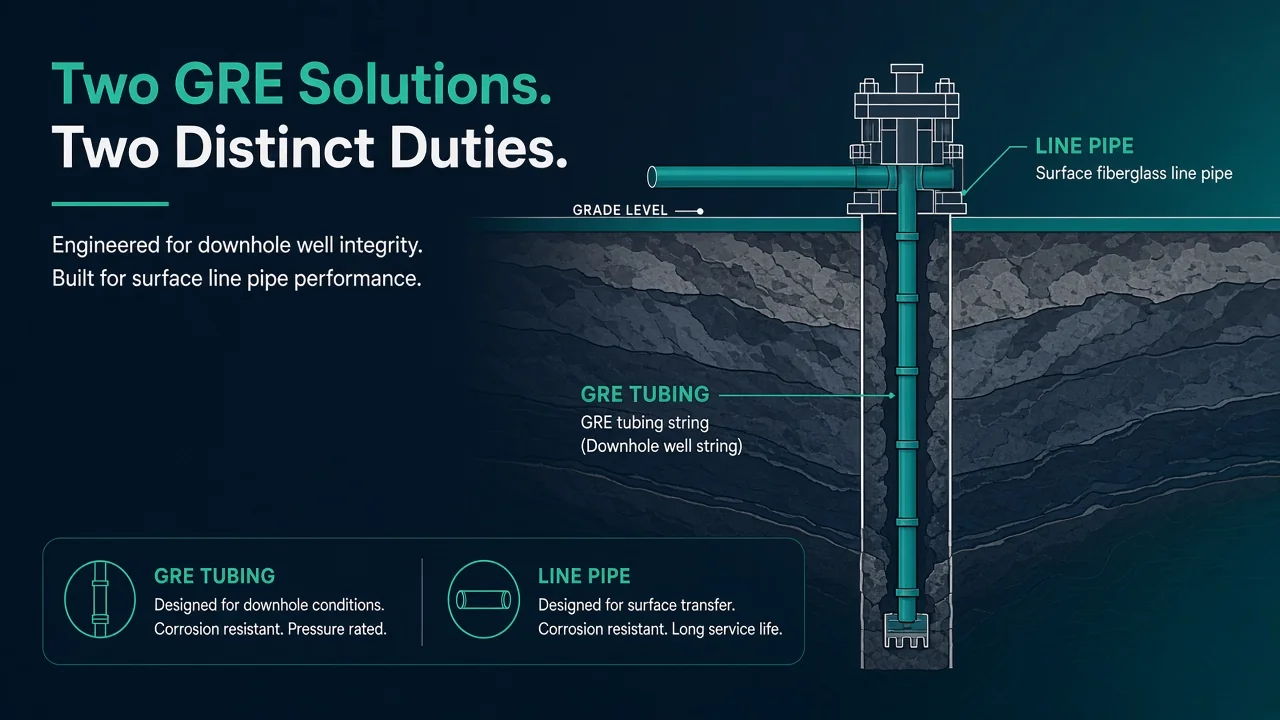
Tubing is a well string, not a flowline
GRE names the material family: glass-reinforced epoxy. Tubing names the duty: a string run in a well. Line pipe names a different duty: surface, buried, or facility flowlines. The same epoxy-and-glass conversation can appear on both product pages. Install method, joints, handling, tally, and documents do not match.
Do not use this page to re-explain GRE vs GRP, and do not rebuild the API 15HR / 15LR / 15S map here. If the drawing is a flowline, open high-pressure fiberglass line pipe or the API 15HR and API 15LR FRP pipeline page instead of forcing tubing language onto a buried line.
Steel production tubing is a third package. Grade, connection, and sour-service fields belong on the OCTG casing and tubing buyer guide. Do not paste a GRE tubing line into a steel OCTG tally, or the reverse.
Selector — GRE tubing vs fiberglass line pipe
| Line item | What you are buying | Install cue | What the RFQ must state on its own line |
|---|---|---|---|
| GRE tubing | Downhole / well tubular for injection or a similar stated well duty | Run in hole; joints and handling for a tubing string; well medium | Well type, medium, pressure–temperature window, size (OD/ID or DN), joint or thread family, quantity or tally, destination, documents |
| Fiberglass line pipe | Flowline, gathering, or facility pipe | Buried, above ground, or shop spool; fittings often govern the system | Route, burial or supports, fitting list, length, fluid and P–T — not a tubing tally |
| Steel OCTG tubing | Metal well tubular | API steel grade and connection | Separate RFQ. Not a substitute GRE size |
Product pages currently describe GRE tubing duties such as water injection, sewage reinjection, polymer injection, and, on the 15LR tubing page, geothermal. Treat that list as a starting scope, not a guarantee that every fluid, temperature, or joint on your well is covered. Ask for compatibility and ratings against the offered construction.

Where API 15HR and API 15LR sit — pointer only
If the tubing line already says API 15HR or API 15LR, keep that name as a family cue only:
- API 15HR is the usual high-pressure fiberglass conversation (rigid GRE/FRP). It is a specification family. It is not a “15-hour design life.”
- API 15LR is the usual low-pressure fiberglass conversation. It is not a shorter copy of 15HR with the same joints and classes.
Do not settle 15HR versus 15LR versus spoolable RTP (API 15S) on this page. For background already published, read API 15HR pipeline notes and API 15LR low-pressure guidelines, then finish the tubing RFQ here.
A catalogue line that says “API 15HR” or “API 15LR” is not proof of a Monogram license for your size, joint, or factory. Evidence is configuration-specific. Ask for documents that name the offered tubing — not a seal on a slide. This article does not claim Monogram coverage and does not reprint pressure, temperature, or diameter tables. Confirm any figure on a live product page against the written offer.
What to put on the tubing RFQ
Before commercial comparison, put every bidder on the same board:
- Duty split — one line for the GRE tubing string; a different line if line pipe is also required.
- Well and fluid — well type, medium, normal and maximum pressure and temperature, plus any CO2, H2S, solids, or chemical-treatment flags already known. Do not assume universal chemical resistance.
- Size and joint — OD/ID or DN, and the joint or thread family the well program already uses. Do not leave “GRE thread” blank.
- Spec family and edition — 15HR or 15LR only if the project names it, plus publication year and any required errata.
- Evidence — factory, process, and the qualification or traceability documents for this configuration. “API certified” is not a document trail.
- Commercial frame — quantity or joint tally, destination, and document language.
Product pages say construction can follow customer requirements. That is an engineering conversation, not approval of unstated ratings. Keep surface fiberglass on the line-pipe pages so the quote does not mix a flowline with a downhole tally.

Quote path
A usable GRE tubing brief fits on one page when it states:
- That the item is downhole / well tubing, not line pipe and not steel OCTG.
- Fluid, pressure–temperature window, size, joint family, and quantity.
- Whether the project cites API 15HR or API 15LR, and which edition.
- Destination and the documents required before a purchase order.
Open API 15HR GRE tubing or API 15LR GRE tubing for the product path that matches the family you already named, use fiberglass pipes if you still need the systems map, and submit the brief through request a quote. CNPS should quote the written scope, not the keyword alone.

FAQ
Is GRE tubing the same product as GRE pipe?
No. GRE is the material. Tubing is the well string. Line pipe is the flowline. Write separate RFQ lines even when both are fiberglass.
Does API 15HR mean a 15-hour design life?
No. API 15HR is a high-pressure fiberglass specification family. Design life, pressure, and temperature come from the offered construction and the governing edition.
Should this page choose 15HR or 15LR for me?
No. If the well program already cites one family, name it and ask for edition, factory, size, joint, and documents. A brochure label is not Monogram evidence, and this page is not the full standards selector.
Can steel OCTG tubing and GRE tubing share one line item?
No. Steel tubulars use grade and connection language. GRE tubing needs fluid, a composite joint, and fiberglass documents. Mixed lines cannot be compared.
Related reading on CNPS
- GRE vs GRP pipes — terminology only; not a tubing RFQ
- High-pressure fiberglass line pipe — flowline path, not a well tally
- API 15HR notes and API 15LR guidelines — family background, not a redo of the tubing brief
- OCTG casing and tubing — steel tubulars


