
API 15HR, API 15LR, and API 15S — Pick the Right Spec Family Before You RFQ
Procurement teams search API 15HR, API 15LR, and API 15S when a line list already implies non-metallic pipe — but the RFQ still mixes rigid fiberglass with spoolable RTP, or high-pressure GRE with low-pressure FRP fittings. Those three API families are not interchangeable. This page is a buyer selector: which family to name, what construction cue to expect, and which evidence fields to request before a quote is useful.
CNPS routes fiberglass systems through fiberglass pipes, high- and low-pressure FRP/GRE through API 15HR and API 15LR FRP pipeline plus API 15HR GRE tubing and API 15LR GRE tubing, and spoolable composite through reinforced thermoplastic pipe (RTP). Send a structured brief via request a quote.
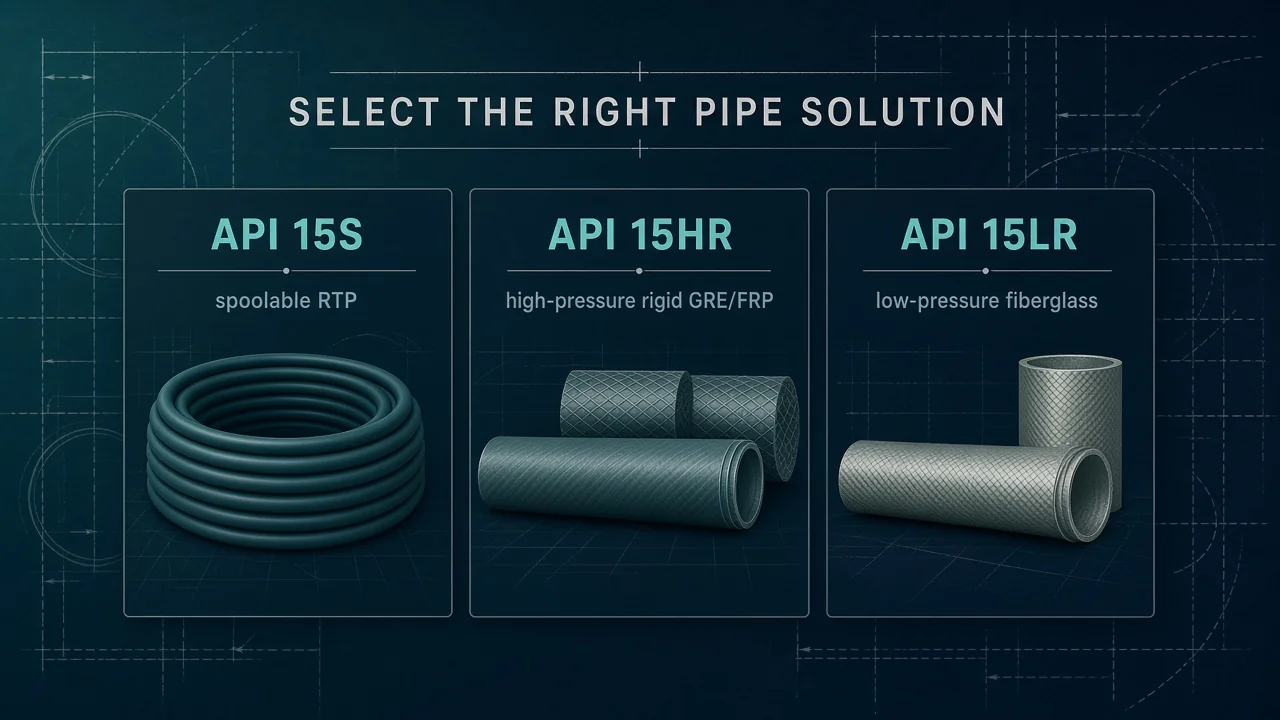
Why buyers mix 15S, 15HR, and 15LR
On tenders, “API fiberglass” or “API composite” often collapses three different product conversations:
- Rigid high-pressure fiberglass — typically discussed under API 15HR (GRE/FRP line pipe or tubing language).
- Rigid low-pressure fiberglass — typically discussed under API 15LR (line pipe and fittings language).
- Spoolable reinforced plastic line pipe — typically discussed under API 15S (RTP family conversation).
Background articles already cover pieces of this map: API 15LR guidelines, API 15HR pipeline integrity notes, 15LR and 15HR in drilling operations, and API Spec 15S overview. Keep those for depth. Use this page to stop an RFQ from naming the wrong family.
Selector table — 15S vs 15HR vs 15LR
| Spec family | Pipe family conversation | Typical construction cue | What the RFQ must state |
|---|---|---|---|
| API 15S | Spoolable reinforced plastic line pipe (RTP) | Thermoplastic liner + reinforcement + outer cover; reel / spoolable install language | Fluid, P–T window, OD/ID, length on reel, end fittings, burial vs surface, factory/configuration, edition, and documents tied to that offer |
| API 15HR | High-pressure fiberglass (rigid GRE/FRP) line pipe / tubing | Glass-reinforced epoxy (or stated FRP system); stick pipe; high-pressure design language | Service (e.g. injection / flowline), P–T, size/class, joints, fittings, well or line duty, edition/errata, factory, qualification scope |
| API 15LR | Low-pressure fiberglass line pipe / fittings | Rigid fiberglass system sized for lower pressure service; fittings often control the system | Fluid, P–T, diameter range, fitting list, joint family, installation (buried/above ground), edition, factory, and system-level evidence |
Do not treat brochure names as proof that a given size or joint is Monogram-licensed. Monogram / license evidence is factory- and configuration-specific. Ask for documents that name the offered construction — not a seal drawn on a slide.

API 15HR — high-pressure rigid fiberglass path
When the duty is high-pressure oilfield fiberglass line pipe or tubing, start the conversation in the API 15HR family. Buyers usually need stick GRE/FRP, a stated pressure–temperature envelope, and a joint system that matches the line list — not a reel of thermoplastic pipe.
Use the product pages for configuration language: API 15HR and API 15LR FRP pipeline and API 15HR GRE tubing. Confirm ratings against the offered construction and the governing edition. Do not copy a pressure or temperature number from marketing text into a purchase order without tying it to size, joint, and document package.
API 15LR — low-pressure fiberglass path
API 15LR is the low-pressure fiberglass line-pipe and fittings conversation. It is not a “lighter brochure version” of 15HR with the same joints and classes. Fittings, adhesives, and field joints often govern the usable system rating.
Route low-pressure FRP/GRE lines through the same FRP pipeline product page and API 15LR GRE tubing, and keep fiberglass pipes as the systems hub (FRP / GRP / GRE terminology). If the project is clearly spoolable RTP, do not force 15LR language onto a reel product — switch to the 15S / RTP path below.
API 15S — spoolable RTP path
API 15S belongs with spoolable reinforced plastic line pipe — the RTP family. Construction cues differ from rigid GRE: thermoplastic liner, reinforcement layers, outer cover, and reel-based logistics. Evidence remains factory- and configuration-specific; a product named “API 15S” in a catalogue is not a substitute for the edition, qualification scope, and end-fitting documents on the offer.
Feed that path through reinforced thermoplastic pipe (RTP). For RTP background already on site, keep API Spec 15S as related reading — this selector page stays focused on RFQ routing, not encyclopedia rewrite.
Evidence checklist — what to request on every offer
Before commercial comparison, put every bidder on the same evidence board:
- Edition / errata — which publication year (and errata, if required) governs the offer.
- Factory and process — which plant and process make the pipe and fittings on this line.
- Size / class / joint — OD/ID or DN, pressure class language used by the manufacturer, end fittings and joint family.
- Fluid and P–T — service medium, normal/max pressure, temperature window, cycles or vacuum if relevant.
- Documents — qualification or type-test scope tied to the offered configuration, ITP/certificates/traceability as the project requires, installer or field-joint notes when joints control the system.
Do not accept a generic “API certified” phrase without a document trail to the exact construction. Do not invent CNPS Monogram coverage for every size — request the evidence fields above and quote against the written scope.

RFQ next step — send one controlled brief
A useful RFQ for API 15HR, API 15LR, or API 15S fits on one page if it states:
- Spec family (15S / 15HR / 15LR) and why that family fits the install method.
- Fluid, pressure–temperature window, OD (or DN), length or reel length, joints/end fittings.
- Buried vs above-ground (or downhole duty for tubing), destination, quantity, and document language.
- Whether the line is rigid fiberglass or spoolable RTP — never both under one vague “API composite” line.
Submit that package through request a quote. CNPS will route against the fiberglass hub, FRP/GRE product pages, or RTP product page above — not against a search phrase alone.

FAQ
Are API 15S, API 15HR, and API 15LR interchangeable? No. 15S is the spoolable reinforced plastic (RTP) conversation. 15HR is high-pressure rigid fiberglass. 15LR is low-pressure fiberglass line pipe and fittings. Name the family that matches construction and install method.
Does a brochure “API 15HR” or “API 15S” label prove Monogram license for my size? Not by itself. Ask for edition, factory, size/class, joints, and documents tied to the offered configuration.
Where should I start if I only know “fiberglass or RTP”? Start at fiberglass pipes for rigid systems and RTP for spoolable lines, then lock 15HR / 15LR / 15S language before pricing.


