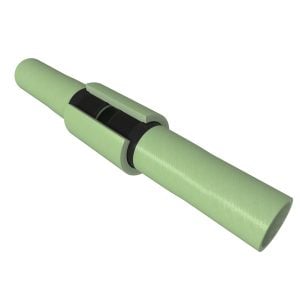
Reinforced thermoplastic pipe (RTP) is a flexible or spoolable composite pipe built around a thermoplastic liner, a load-bearing reinforcement layer and an outer protective cover. Product capability depends on the exact liner, reinforcement, cover, end fittings, size and qualification. “RTP” does not by itself prove a pressure, temperature, chemical-compatibility or API rating.
How RTP is constructed
A typical RTP system uses three functional layers. The inner thermoplastic liner contains the transported fluid. The reinforcement carries pressure and other mechanical loads and may use polymer fibers, glass, aramid, steel or another qualified construction. The outer cover protects the reinforcement during manufacture, transport, installation and service. Manufacturers may use additional layers or tapes, so the offered cross-section should be confirmed from the product data sheet.
The end fittings and couplings are part of the pressure-containing system. Their materials, sealing mechanism, attachment to the pipe and qualification must match the service. A long spool can reduce the number of field joints, but each termination, repair or intermediate connection remains a critical interface.
RTP, TCP and rigid fiberglass pipe are not synonyms
| Pipe family | General construction | Selection focus |
|---|---|---|
| RTP | Thermoplastic liner, reinforcement and outer cover; generally flexible/spoolable | Qualification, pressure-temperature envelope, fluid compatibility, end fittings, reel and installation controls. |
| TCP | Thermoplastic composite pipe; terminology and bonding architecture vary by manufacturer | Do not infer performance from the label. Review the manufacturer’s defined construction and qualification. |
| GRE/GRP | Rigid thermosetting-resin pipe reinforced with glass fibers | Resin, laminate, fittings, joints, pressure class and applicable fiberglass standard. |
For the fiberglass terminology route, see GRE pipe full form and GRP versus GRE. For a broader system comparison, use the fiberglass pipe systems guide.
API 15S and RTP
API Specification 15S addresses spoolable reinforced plastic line pipe for oilfield and energy applications. API’s public description includes transport of multiphase fluids, hydrocarbon gases and liquids, production chemicals and nonpotable water. It describes a liner with helically wrapped metallic or nonmetallic reinforcement and an outer cover, together with requirements for pipe and end fittings or couplings.
Not every RTP product is automatically API 15S-qualified, and API 15S is not the only possible project requirement. The quotation should identify the standard edition, product family, factory, size, pressure class, temperature basis, reinforcement and end-fitting configuration covered by the evidence. Offshore use may require additional project and regulatory requirements beyond the public API scope.
Review API’s public API 15S scope summary and current API addenda and update register. API lists a third-edition update and later addendum in its current program information. Use the official contracted edition and project specification for design and acceptance.
Where RTP may create value
RTP may be considered where corrosion, installation speed, long continuous lengths or reduced handling weight are important. Possible oilfield routes include gathering, water service, injection and other line duties when the exact product is qualified for the medium and operating envelope. Suitability for gas, sour exposure, hydrocarbons, chemicals, high temperature, cyclic pressure or permeation-sensitive service cannot be assumed from the material name.
Long reel lengths can reduce joints and field assembly, but reel dimensions, transport limits, minimum bend radius, pull forces, terrain, right-of-way and termination work must be planned. The best lifecycle result comes from coordinating the pipe, end fittings, installation equipment, trained personnel, inspection and operating controls as one system.
Inputs required for RTP selection
Fluid and permeation basis
Provide all fluid phases and compositions, including water chemistry, hydrocarbons, gases, CO₂, H₂S where applicable, production chemicals, solids and cleaning fluids. Ask the supplier to state compatibility, permeation considerations and decompression or pressure-cycling limitations for the specific liner and reinforcement system.
Pressure-temperature envelope
State normal, maximum and design pressure, surge, vacuum, start-up, shutdown and cycle profile. Provide minimum, normal and maximum temperatures for fluid, ambient, storage and installation. Ask for the qualified pressure-temperature relationship rather than comparing products at a single headline rating.
Mechanical and installation loads
Define minimum bend radius, reel and transport limits, pulling or laying method, trench and backfill, supports, anchors, thermal movement, terrain, crossings, external pressure, buoyancy and other site loads. Identify whether the line is buried, surface-laid, suspended or installed through a conduit. Installation instructions are part of the technical design basis.
End fittings and interfaces
List end connections, couplings, flanges, valves, pigging or cleaning interfaces, metallic transitions, pressure-test points and electrical or grounding considerations. Confirm materials, seals, corrosion protection, make-up tooling, installer qualification, inspection and repair procedures.
RTP RFQ checklist
- Application: line function, onshore/offshore context, design life and governing authority.
- Process data: fluid composition, pressure, temperature, cycles, flow, gas, solids and chemical treatment.
- Dimensions: required internal diameter or hydraulic performance, total length, segment plan and quantities.
- Interfaces: end fittings, intermediate fittings, flanges, valves, equipment and metallic transitions.
- Route: terrain, crossings, burial, supports, pull length, minimum bend radius, access and reel constraints.
- Installation scope: reels, handling equipment, field services, supervision, training, assembly, inspection and testing.
- Evidence: qualification, pressure-temperature envelope, compatibility, traceability, ITP, certificates, test reports and manuals.
- Delivery: destination, packing, transport limits, storage, schedule, spares and document dates.
Evidence to review
- manufacturer, factory and product-family identification;
- cross-section and controlled materials for liner, reinforcement, cover and fittings;
- qualified sizes, pressure classes, temperature range and end fittings;
- test basis for cyclic pressure, long-term performance and relevant service exposures;
- chemical-compatibility and permeation limitations for the intended medium;
- quality plan, inspection, marking and traceability records;
- reel, handling, storage, minimum bend radius and installation requirements;
- field-joint, termination, pressure-test, inspection and repair procedures;
- standard-license scope when the purchase order requires an API Monogram.
Plan the route, reels and field execution together
RTP project planning starts before a reel reaches the site. Divide the route into installable lengths using reel capacity, transport access, bridge and road limits, handling equipment, right-of-way geometry, crossings, pull forces and the qualified minimum bend radius. Locate terminations and intermediate connections where they can be assembled, inspected, protected and accessed later. Confirm how reel transitions, temporary restraints and stored energy will be controlled.
The method statement should identify the approved handling attachments, payout orientation, allowable tension and sidewall pressure, temperature limits, trench or support acceptance, cover protection and damage criteria. It should also define end-fitting preparation, tooling, operator qualification, dimensional checks, make-up records and inspection. If the line is pulled through a conduit or crossing, calculate and monitor the applicable loads rather than relying only on a planned pull length.
Commissioning should use a configuration-specific pressure-test procedure with safe exclusion zones, calibrated instruments, stabilization, acceptance limits and a response plan. Link each installed reel and end fitting to manufacturing traceability, inspection, field-assembly and test records. Handover should include operating limits, permeation and venting provisions where applicable, inspection guidance, repair methods and spare-fitting requirements.
Manage configuration changes after award
A change in liner polymer, reinforcement, cover, size, pressure class, end fitting, factory or installation method can change the qualification basis. Maintain a configuration register from bid clarification through purchase, manufacture, installation and operation. Route substitutions and deviations through the designated engineering authority, with updated compatibility, qualification and installation evidence. This is especially important when a product-family certificate covers more variants than the specific configuration offered to the project.
Common RTP specification mistakes
- treating all three-layer pipes as equivalent;
- copying a maximum pressure or temperature without its size, service and qualification basis;
- omitting gas permeation, sour exposure, decompression, pressure cycles or cleaning chemicals;
- selecting the pipe body before the end fittings and metallic interfaces;
- ignoring reel dimensions, minimum bend radius, pull forces and transport access;
- assuming fewer joints eliminate the need for trained installation and inspection;
- claiming API 15S compliance without factory- and configuration-specific evidence;
- using RTP, TCP and GRE as interchangeable search or specification terms.
Commercial review without a fake public price
RTP is normally quoted against a defined project scope. Price per meter alone is not comparable when products differ in internal diameter, pressure-temperature capability, reel length, end fittings, field services, inspection and delivery. A responsible quotation separates pipe, fittings, reels or packaging, installation tooling, supervision, testing, spares, documentation and freight.
CNPS does not add a placeholder public offer or fabricated review score solely to qualify for product rich results. Provide the engineering inputs so an actual configuration and quotation can be reviewed.
Frequently asked questions
What does RTP stand for?
RTP stands for reinforced thermoplastic pipe. A typical system uses a thermoplastic liner, reinforcement and an outer protective cover.
Is RTP the same as GRE pipe?
No. RTP uses a thermoplastic liner in a flexible or spoolable construction. GRE is rigid glass-reinforced epoxy, a thermosetting composite.
Does all RTP comply with API 15S?
No. API 15S is a product specification. Compliance or Monogram claims require evidence tied to the exact manufacturer, factory, product family, size, pressure class and end-fitting configuration.
What information is needed for an RTP quotation?
Provide fluid composition, pressure-temperature and cycle envelope, required hydraulic size and length, fittings, route and installation conditions, standard, documentation, quantity, destination and schedule.
Continue the nonmetallic pipe review
Compare fiberglass pipe systems, review the API 15S explainer, and use non-metallic pipe products to locate related configurations.
Send the medium, pressure-temperature cycles, internal diameter, length, fittings, route, installation method, quantity, destination and required evidence.